Best HRMS Software for SMEs in India (2026)
IntroductionΒ
Choosing the best HRMS software for SMES in India doesnβt have to be overwhelming. Today, HR platforms do much more than automate daily tasks β they run accurate payroll, ensure multi-state compliance, and centralize operations.
Driven by updated regulations like the Code on Wages and Social Security, Indian SMEs are upgrading to integrated systems to manage onboarding, attendance, performance, and insights from a single dashboard.
This guide compares the leading HRMS software for SMEs in India, breaking down their key features and limitations so you can make a confident and informed decision.
What isΒ anΒ HRMS Software?Β
An HRMS (Human Resource Management System) is software that automates and manages HR procedures, such as employee records, recruitment, attendance monitoring, payroll processing, statutory compliance, performance reviews, and analytics, all from a single dashboard. It helps decrease human errors, accelerates HR cycles, improves compliance, and enhancesΒ employeeΒ experience.Β
Importance of HRMS Software in 2026Β
In 2026, HRMS has become indispensable for Indian businesses because it offers:Β
- Full statutory complianceΒ with India-specific payroll andΒ labourΒ laws.Β Β
- Remote and hybrid workforce managementΒ (geo-tagged attendance, mobile apps).Β Β
- Scalable payroll automation, especially important with evolving tax rules.Β Β
- Employee self-service (ESS) portalsΒ that reduce HR workload.Β Β
- Data-driven decisionsΒ using HR analytics and dashboards.Β
What to look for in the Best HRMS SoftwareΒ (in India)?
If you are a seasoned HR professional or just stepping into a role where you need to choose an HRMS (Human Resource Management System) for your team, the evaluation part is key. The software platform should be able handle everything from paying employees to tracking attendance, hiring new staff, and monitoring performance β all in one place. Choosing the right one for your organization is one of the most important decisions you will make, and it does not have to be overwhelming. Keep reading to know what exactly to look for.Β
Features and ModulesΒ
Think of an HRMS as a toolbox β the more relevant tools it has, the more work it can do for you. When evaluating a system, check that it covers these core features, among others to choose the right fit for your organization.Β
Payroll AutomationΒ
Manually calculating salaries, deductions, and bonuses every month is time-consuming andΒ error prone. A good HRMS automates this entire process β it calculates pay based on attendance, applies applicable deductions (like PF or TDS), and generatesΒ payslipsΒ automatically. Look for a system that handles multi-componentΒ salary structures, including basic pay, HRA, and allowances.Β
Attendance and Leave ManagementΒ
This module tracks when employees check in and out, manages leave requests and approvals, andΒ maintainsΒ a clear record of absences. For HR professionals, this can save hours each week.Β The systemΒ shouldΒ integrate with biometric devices or support mobileΒ location-based or even selfie-attendence.Β That employees can apply for leaves, approvals, etc.Β through a self-service portal.Β
Recruitment and OnboardingΒ
A built-in applicant tracking system (ATS) helps you post job openings,Β uploadΒ resumes, schedule interviews, and communicate with candidates β all from one dashboard. The onboarding moduleΒ shouldΒ ensure new hires complete their paperwork, receiveΒ onboardingΒ documents, and are set up in the system before their first day. ThisΒ results inΒ a smooth and professional experience for both the HR team and the new employee.Β
Performance and Engagement ToolsΒ
These features allow managers and HR to setΒ KPIs/OKRs, conduct appraisals, collect feedback, andΒ facilitateΒ employee engagement.Β ThisΒ featureΒ is valuable because it replaces scattered spreadsheets and paper forms with a structured, trackable process. Some platforms also include pulse surveys,Β recognition tools,Β andΒ a social feedΒ toΒ understand the general employee morale.Β
ComplianceΒ
Compliance is one of the most critical areas for HR in India, and it is also one where mistakes can be costly. Your HRMS must support the following statutory requirements:
- Provident Fund (PF): Calculates contributions on the statutory base, enforcing the 50% basic-wage CTC rule under the new codes.
- Employee State Insurance (ESI): Tracks gross wage ceilings and automates ESI deductions and return filings for eligible staff.
- Tax Deducted at Source (TDS): Manages multi-regime tax liabilities, dynamic employee selection, and automated Form 16 generation.
- Professional Tax (PT): Automates state-wise slab calculations and local compliance return tracking.
- Wage Code Restructuring: Audits allowance-to-basic ratios in CTC to prevent illegal under-reporting of statutory contributions.
- Gratuity & Fixed-Term Employment: Calculates redefined gratuity bases and enables pro-rata payouts for fixed-term employees without the 5-year wait.
- Gig & Social Security Coverage: Classifies non-standard workers to manage aggregator cess and social security tracking under the new framework.
As an HR professional, you may not be expected to know every detail of these regulations immediately β but your HRMS should make it easy to stay compliant automatically. Always confirm with your vendor that the system is updated with the latest government regulations.
ScalabilityΒ
When you join a growing organization or will grow in the near future, the HRMS you choose today should be able to grow with your business tomorrow β from an early-stage startup to a mid-size company, and eventually to a large enterprise β without migrating to other more equipped platforms. Having to use a platform for your current situation might seem like a great option (which it is) but if that platform cannot scale with the company, last minute migration can lead to many unforeseeable issues due to hasty setups, leading to unnecessary fines.Β
Pricing and ValueΒ
Budget conversations can feelΒ difficult as features donβt match your budgets, but understanding pricing models helps you make a strong business caseΒ forΒ your manager or leadership team. Most HRMS platforms use one of the following models:Β
- Per-employee pricing:Β You pay a fixed monthly fee for each active employee. This is predictable and scales directly with your headcount.Β
- Flat fee pricing:Β A fixed monthly or annual cost regardless of employee count. This can offer better value for larger teams.Β
- Hybrid pricing:Β A nominal monthly fixed fee and a variable per employee fee whichΒ gives you highΒ predictiblityΒ of per-employee pricing as well as better valueΒ deliveredΒ by flat fee pricing.Β
Beyond the headline price, consider the total cost of ownership β this includes: Β
- Implementation feesΒ
- Training costsΒ
- Hidden charges forΒ additionalΒ βincludedβΒ modulesΒ
- Ongoing supportΒ
ProΒ Tip:Β Do not rush the decision. Create a shortlist of 2-3 platforms, involve your manager or finance team in the conversation, and evaluate each one against the criteria above. The right HRMS will save you hours every week and help you build a stronger, more compliant HR function from day one.Β
How Did We Evaluate the Best HRMS Software for Indian SMEs?
To build an objective list of the top HRMS platforms for growing Indian businesses, we evaluated each software against the key operational needs of HR teams and employees. Our evaluation focused on five main pillars:
India-Specific Payroll & Statutory Compliance: We reviewed how effectively each system handles multi-component salary calculations and automates local statutory requirements, including 50% wage rule, EPF, ESIC, TDS, and state-level Professional Tax (PT), DPDP compliance, among many others.
Core HR & Attendance Features: We assessed essential modules, such as leave management, recruitment/ATS, performance tracking, and flexible attendance tools like biometric sync and GPS-based mobile check-ins.
User Experience & Self-Service: We evaluated the ease of use for both HR admins and employees, focusing on clean dashboard interfaces and functional Employee Self-Service (ESS) mobile apps.
Scalability & Hybrid Work Capabilities: We checked whether the platform can easily scale as an SME grows, supporting remote workforces, multi-location setups, and expanding headcounts.
Pricing & Value: We examined pricing models (per-employee, flat, and hybrid fees) along with potential implementation costs to ensure total value for money.
Market Comparison GuideΒ
After evaluating each platform against the core criteria outlined above β ranging from statutory compliance to overall usability β we have shortlisted 10 leading HRMS software platforms. Please note that these tools are listed in no particular order, and the numbering is provided purely for structural reference rather than to rank or reflect their relative capabilities.
| HRMS Software | Best For | Standout Feature |
|---|---|---|
|
Growing Starups & SMEs | Integrated HRMS Software + Payroll Automation |
|
Mid-size & growing teams | Strong payroll + engagement tools |
|
Startups & SMEs | Seamless integrations + flexible workflows |
|
Complianceβcentric teams | Best statutory compliance tools |

|
SMEs with automation focus | AIβbacked HR automation |
|
SMEs & field teams | Attendance + payroll focus |
|
Midβsized companies | Userβcentric HR workflows |
|
Large enterprises | Advanced automation and analytics |
|
Multiβlocation operations | Comprehensive HR features |
|
SMEs | Simple and scalable HRMS |
1. Zoho People: Small Part of a Complex EcosystemΒ

OverviewΒ
Zoho People is a cloud-based HRMS within the Zoho ecosystem, offering HR database management, onboarding, workflow automation,Β leaveΒ and attendance tracking.Β ItβsΒ especially useful for businesses already using Zoho apps.Β Β
ProsΒ
βΒ Popular with high adoptionΒ
βΒ Supports workflow automationΒ
βΒ Integration available but only with Zoho suiteΒ
ConsΒ
βΒ Requires Zoho Payroll add-on for payroll capabilitiesΒ
βΒ Setup and complex process configuration needs support from third-party vendorsΒ
βΒ Minimal support from Zohoβs in-house team, premium support plan neededΒ
2. Keka: Premium Tool for Enterprise BusinessesΒ

Overview
Keka offers payroll, HR, performance management, and applicant tracking in a unified dashboard.Β ItβsΒ known for smooth workflow automation and strong payroll processing suited for companies scaling their HR operations.Β Β
ProsΒ
βΒ Modern UI with a payroll engineΒ
βΒ Performance reviews and engagement toolsΒ
βΒ Good mobile experienceΒ
ConsΒ
βΒ Pricing can be high for small to mid-sized teamsΒ
βΒ Feature complexity is high and requires training
3. Quikchex: Full-suite HRMS Software with Deep Payroll Integration
Overview
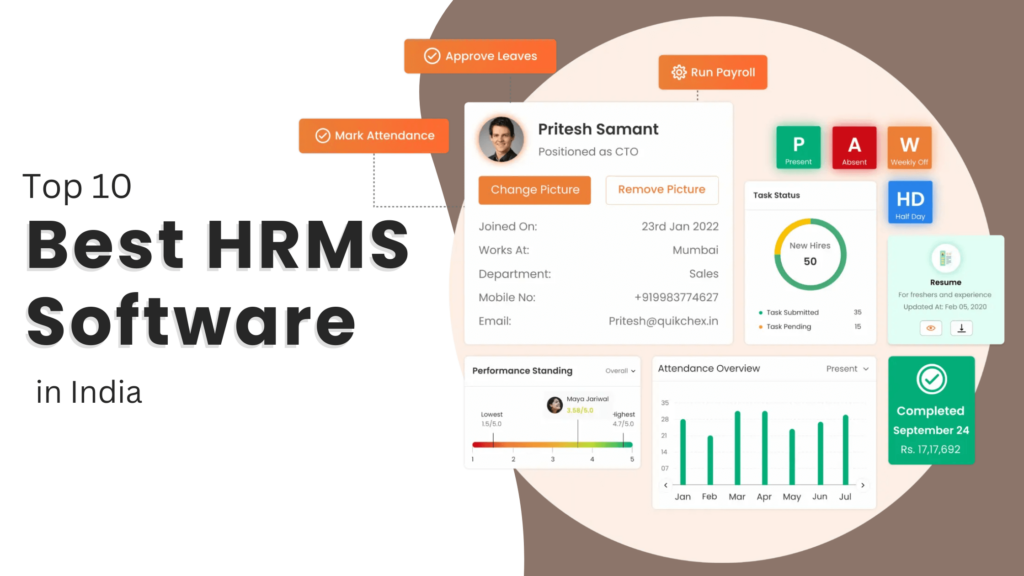
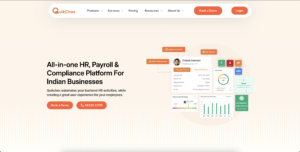
Quikchex is a comprehensive HRMS software tailored for small and medium sized (SMEs) Indian businesses in growth mode. This is because the Quikchex platform centralizes HR, payroll, attendance, leave, recruitment, performance, compliance, and analytics into a single system. The solution automates payroll and has statutory compliance meaningfully built into the software DNA to make payroll processing stress-free and easy.
ProsΒ
β All-in-one HR and payroll software with an option to outsource payroll to the in-house experts
βΒ Strong Indian payroll and compliance automation (EPF/ESIC/TDS)Β
βΒ Mobile attendance tracking and GPS-based featuresΒ
βΒ User-friendly interface and quick onboardingΒ
ConsΒ
βΒ Due to the modular nature, final pricing may require contact to get a tailored planΒ
βΒ Complex and highly customized requests require setup assistance
4. GreytHR: Best for Businesses Needing Compliance-Centric ToolsΒ

Overview
GreytHRΒ is a trusted HRMS with excellent payroll and statutory compliance support, perfect for small and medium teams focused onΒ accurateΒ reporting and adherence to IndianΒ labourΒ laws.Β Β
ProsΒ
βΒ Reliable payroll and compliance automationΒ
βΒ Easy attendance and leave trackingΒ
βΒ Legacy businessΒ
ConsΒ
βΒ UI feels dated compared to modern platformsΒ
βΒ Limited advanced HR featuresΒ
5. Zimyo: Known for HR Automation Β

OverviewΒ
ZimyoΒ offers an AI-powered HRMS covering payroll, attendance, performance, and employee engagement modules. Its cloud platform centralizes HR workflows and improves operational efficiency.Β Β
ProsΒ
βΒ Extensive automation + employee ESS portalΒ
βΒ Configurable workflows and dashboardsΒ
βΒ Mobile accessibleΒ
ConsΒ
βΒ Some advanced setup requiredΒ
βΒ Support experience can varyΒ
6. factoHR: Good For Only Core HR FeaturesΒ

Overview
factoHRΒ focuses on giving SMEs a simple yet powerful HRMS with core HR, payroll, attendance, and compliance modules β widely used across Indian businesses with field teams.Β Β
ProsΒ
βΒ Strong core HR and payroll featuresΒ
βΒ Easy to implementΒ
ConsΒ
βΒ UI can feel less modernΒ
βΒ Less powerful analytics
7. HROne: Best for Small Businesses/StartupsΒ

OverviewΒ
HROne simplifies HR operations with strong core HR, payroll, recruitment, and performance modules β often favored by companies that want an intuitive workflow similar to an email-style HR inbox. Β
ProsΒ
βΒ Easy to use for HR teamsΒ
βΒ Good attendance and recruitment modulesΒ
ConsΒ
βΒ Custom pricing onlyΒ
βΒ Steeper learning curveΒ
8. Darwinbox: Best for Multi-national EnterprisesΒ

OverviewΒ
DarwinboxΒ is an enterprise-grade HRMS with advanced analytics, AI insights, and mobile-first user experience for complex organizations.Β Β
Pros
βΒ Scalable with deep automationΒ
βΒ Advanced workforce insightsΒ
ConsΒ
βΒ Higher cost and complex implementationΒ
βΒ Performance slowdowns may occur when handling large data volumes or complex reportsΒ
9. ZingHR: Best for Legacy Businesses

Overview
ZingHR offers comprehensive HR modules with strong performance, workforce, and compliance tools β ideal for companies spread across different locations. Β
Pros
βΒ Wide range of HR featuresΒ
βΒ Strong performance and engagement toolsΒ
Cons
βΒ Complex setup processΒ
βΒ Some users report UI challenges
10. Pocket HRMS: Best for Small Businesses/Startups (<25 Employees)Β

Overview
Pocket HRMS provides core HR, payroll, attendance, and employee self-service features with AI-driven tools like chatbots for SME teams seeking simple solutions.Β Β
ProsΒ
βΒ AI chatbot and automationΒ
βΒ Affordable pricingΒ
Cons
βΒ Less scalable for large enterprisesΒ
βΒ UI may feel outdated to some usersΒ
ConclusionΒ
Choosing the best HRMS for your growing company will help your HR function go from an administrative burden to strategic strength. Quikchex balances everything from software, compliance and managed service options making it one of the best value options for SMEs looking for both features and compliance in India.Β
Checklist for Evaluating HRMS Platforms & ServicesΒ
Use this checklist to objectively compare HRMS vendors. It helps businesses evaluate HR software across functionality, compliance, integrations, implementation, and longβterm scalability.Β
Core HR & Employee Data
- Centralized employee databaseΒ
- Custom employee fields and organization chartsΒ
- Role-based access controlsΒ
- Multi-company or multi-entity supportΒ
Payroll & Compliance
- Automated payroll processingΒ
- PF, ESIC, PT, TDS statutory calculationsΒ
- Form 16, FormΒ 24Β and ECR generationΒ
- Flexible salary structures and variable pay supportΒ
Attendance & Time Tracking
- Biometric and mobile attendance integrationsΒ
- Geo-tagged mobile check-inΒ
- Shift and roster managementΒ
- Automatic overtime and leave calculationsΒ
Recruitment & Onboarding
- Built-in applicant tracking system (ATS)Β
- Automated Offer letter generationΒ
- Automated onboarding workflowsΒ
- Background verification integrationsΒ
Performance & Learning
- Goal setting and OKR trackingΒ
- Performance reviews and appraisal cyclesΒ
- 360-degree feedback capabilitiesΒ
- Learning and training management integrationsΒ
Employee Self-Service (ESS)
- Employee portal forΒ payslipsΒ and tax declarationsΒ
- Mobile app access for HR tasksΒ
- Leave and attendance requestsΒ
- Expense claims and reimbursementsΒ
Analytics & Reporting
- HR dashboards and workforce insightsΒ
- Custom report builderΒ
- Attrition and workforce analyticsΒ
- Exportable reports for finance and managementΒ
Integrations
- Accounting software integrationsΒ
- Attendance system integrationsΒ
- Open APIs for custom integrationsΒ
- SSO support for enterprise securityΒ
Security & Data Protection
- Data encryption and secure storageΒ
- Role-based permissionsΒ
- Compliance with security standards β SOC2 Type2 & ISO 27001 Β
- Audit logs and data access tracking Β Β
Implementation & Support
- Dedicated implementation teamΒ
- Data migration supportΒ
- Employee and admin trainingΒ
- Reliable customer supportΒ Β
Pricing & Scalability
- Transparent pricing structureΒ
- Flexible plans for growing teamsΒ
- No hidden costs for essential modulesΒ
- Ability to scale with company growthΒ
FAQsΒ
1. What is an HRMS software?
HRMS (Human Resource Management System) software is a digital tool that lets businesses handleΒ all ofΒ their HR tasks, like payroll, attendance, employee data, leave management, hiring, and compliance, fromΒ a single location.Β
2. Why do companies use HRMS software?
Companies use HRMS software to automate repetitive HR tasks, cut down on payroll mistakes, make sure they follow labor laws, and keep track of employee data inΒ anΒ efficientΒ way.Β
3. What features should a good HRMS software include?
A good HRMS software typically includes:Β
- Payroll managementΒ
- Attendance and leave trackingΒ
- Employee databaseΒ
- Performance managementΒ
- Employee self-service portalΒ
- Compliance managementΒ
- HR analytics and reporting.Β
4. Is HRMS software necessary for small businesses?
Yes. HRMS software is good for small businesses because it cuts down on manual HR work, makes payroll moreΒ accurate, and helps keep track of employee records as the business grows.Β
5. What is the difference between HRMS and HRIS?
While HRMS is more sophisticated and includes payroll, performance management, analytics, and automation tools, HRIS primarily concentrates on storing employee data and fundamental HR procedures.Β
6. How does HRMS software help with payroll?
HRMS software automatically calculates salaries, taxes, bonuses, and deductions based on attendance and policies, reducingΒ errors,Β and ensuringΒ timelyΒ payroll processing.
7. Can HRMS software help with compliance in India?
Yes. Many HRMS platformsΒ assistΒ businesses in avoiding fines andΒ maintainingΒ compliance with Indian labor laws by supporting statutory compliance, including PF, ESIC, TDS, and professional tax.Β
8. What is an employee self-service portal in HRMS?
An employee self-service (ESS) portal allows employees to accessΒ payslips, apply for leave, check attendance, and update personal information without contacting HR.
9. How much does HRMS software cost in India?
Depending on features, modules, and business size, HRMS software in India usually costs between βΉ20 and βΉ150 per employee per month.
10. Which HRMS software is best for payroll and compliance management in India?
HRMS solutions created especially for Indian regulations areΒ frequentlyΒ preferred by companies that need robust payroll automation and support for statutory compliance. Platforms such asΒ QuikchexΒ help businesses lower compliance risks by offering integrated payroll processing and compliance management for PF, ESIC, TDS, and other legal requirements.
11. Can HRMS software improve employee experience?
Yes, self-service portals, quicker HR procedures, and better employee-HR team communication are all ways that HRMS tools promote transparency and improve employee experience.
12. Is HRMS software secure for storing employee data?
Most modern HRMS platforms, such as Quikchex, use secure cloud infrastructure, encryption, and role-based access controls to protect employee data and company information. You also need to make sure to check if your HRMS software provider in India has SOC 2 Type 2 & ISO/IEC 27001:2022 certified.
You can visit our Trust Centre to see how Quikchex is compliant and keeps customer data safe and secure.
Important Note: If you are an Indian business, you need to make sure your data is stored within India.
13. What are the benefits of cloud-based HRMS software?
Cloud HRMS solutions offer:Β
- Remote access from anywhereΒ
- Automatic updatesΒ
- Lower IT maintenance costsΒ
- Real-time workforce data and reports.Β
14. Can HRMS integrate with other business tools?
Yes. Many HRMS systems integrate with:Β
- Accounting softwareΒ
- Biometric attendance systemsΒ
- Recruitment toolsΒ
- Banking systems for payroll processing.Β
15. Is HRMS software scalable for growing businesses?
Yes. The majority of cloud-based HRMS systems are scalable and may help companies expand from small teams to massive corporations. Solutions likeΒ QuikchexΒ offer modular features that can adapt to increasing employee numbers and more complex HR requirements.Β
16. How can I find out if a software has great compliance built into it?
An easy way to find out, even before taking a demo, if compliance is built into the software is to see if the vendor also offers in-house payroll and compliance services. Ultimately, software built by compliance practitioners for compliance practitioners, in-house, will always be more reliable than a system coded by engineers working purely off written regulatory guidelines. Their service arm serves as a continuous, real-world quality test for the software you buy.